

Sand and dust storms: A growing threat driven by land degradation and climate change
News-Events 11/07/2026
Sand and dust storms are becoming increasingly frequent and intense across many parts of the world. No longer confined to arid regions, airborne dust can travel across national borders, affecting the environment, public health, economic activities, transportation, and socio-economic development. This trend underscores that ecosystem restoration and sustainable land management are not only environmental priorities but also urgent measures to reduce the risks posed by sand and dust storms in a changing climate.
1. Drivers behind the increasing occurrence of sand and dust storms
Sand and dust storms are natural phenomena that occur when strong winds lift sand and dust particles from dry or degraded land into the atmosphere. These particles can travel hundreds or even thousands of kilometres through atmospheric circulation, affecting countries and regions far from their source. According to the United Nations Environment Programme (UNEP), the drylands of North Africa, the Arabian Peninsula, Central Asia, and China are among the world's largest sources of mineral dust.
Although sand and dust storms are part of the Earth's natural cycle, human activities have significantly intensified their occurrence. Land degradation, deforestation, overgrazing, unsustainable resource extraction, and unsustainable water use have expanded barren and degraded landscapes, making it easier for winds to mobilize sand and dust. Meanwhile, climate change—through rising temperatures, prolonged droughts, and accelerating desertification—continues to reduce vegetation cover, further increasing the likelihood and severity of sand and dust storms.
UNEP reports that desert dust levels have doubled in some regions during the twentieth century. This indicates that sand and dust storms are no longer merely natural weather events but are increasingly driven by land degradation and climate change. Consequently, the United Nations urges countries to strengthen sustainable land management, restore degraded ecosystems, and reduce greenhouse gas emissions to curb the growing threat.
2. Impacts on the environment, public health, and socio-economic development
Sand and dust storms are not only extreme weather events but also major environmental, public health, and socio-economic challenges. Because airborne dust can travel over vast distances, their impacts frequently extend across national boundaries, affecting areas thousands of kilometres away from their origin.
From an environmental and production perspective, sand and dust storms accelerate land degradation, damage ecosystems, and threaten livelihoods, particularly in arid and semi-arid regions. Thick layers of dust can bury crops, reduce agricultural productivity, harm livestock production, and accelerate the deterioration of machinery, infrastructure, and buildings. Transportation is also severely affected, especially aviation, where reduced visibility often results in flight delays, schedule changes, or cancellations. According to UNEP, sand and dust storms caused nearly US$1 billion in economic losses in northern China over a three-year period.
Public health impacts are equally significant. Windblown dust is an important source of fine particulate matter in the atmosphere. UNEP estimates that approximately 40% of aerosols in the Earth's lowest atmospheric layer consist of windblown dust. Once inhaled, dust particles can irritate the respiratory tract and increase the risk of asthma, pneumonia, and other respiratory diseases. Even more concerning, ultrafine particles can penetrate deep into the lungs, enter the bloodstream, and affect multiple organs. UNEP cites an assessment estimating that exposure to atmospheric dust particles was associated with approximately 400,000 premature deaths worldwide in 2014. In addition, dust can carry disease-causing microorganisms, increasing the risk of infectious disease outbreaks in vulnerable communities.
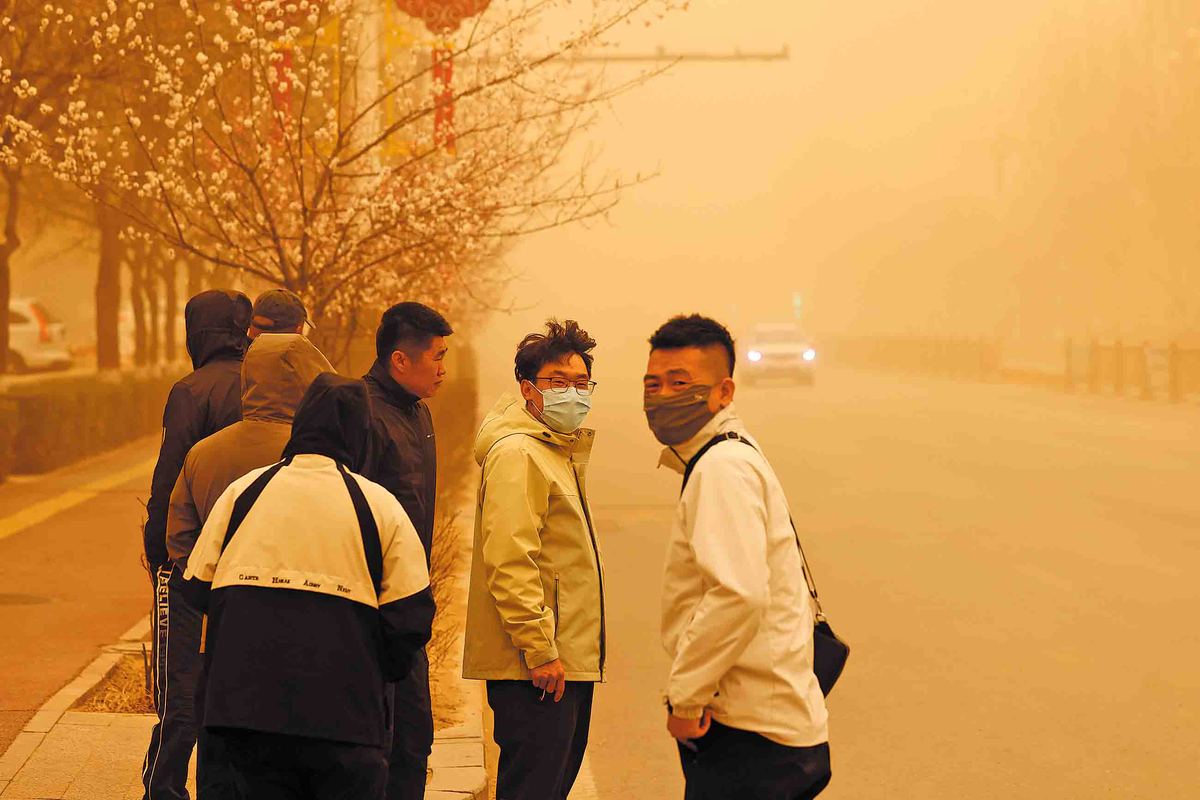
Residents travel along a dust-filled street during strong winds in Alshaa Left Banner, Inner Mongolia Autonomous Region, China, on 11 April 2025 (Wang Weiwei/China Daily).
3. Ecosystem restoration: A sustainable response
Although it is difficult to directly prevent sand and dust storms, their occurrence and impacts can be substantially reduced through sustainable land management and ecosystem restoration. Rather than focusing solely on responding after such events occur, countries should address the root causes, including land degradation, desertification, and climate change.
For arid and semi-arid regions, UNEP recommends improving water-use efficiency, protecting topsoil from erosion, increasing vegetation cover, promoting sustainable agricultural practices, and reducing deforestation and overgrazing. These measures not only reduce the amount of sand and dust entering the atmosphere but also strengthen the resilience of ecosystems and communities to climate change. At the same time, investment in early warning systems can enhance preparedness, enabling governments and communities to minimize loss of life, damage to property, and socio-economic losses.
At the global level, international cooperation remains essential for effectively addressing sand and dust storms. The United Nations General Assembly has proclaimed 2025–2034 as the United Nations Decade on Combating Sand and Dust Storms, while continuing to advance the United Nations Decade on Ecosystem Restoration (2021–2030) to mobilize resources, facilitate knowledge sharing, and scale up land and ecosystem restoration efforts. These initiatives provide a critical foundation for reducing the risks associated with sand and dust storms while addressing land degradation, climate change, and biodiversity loss.
4. Conclusion
Sand and dust storms are natural phenomena that are becoming increasingly severe due to land degradation, desertification, and climate change. Their impacts extend far beyond drylands, affecting the environment, public health, production systems, and socio-economic development on a global scale. Addressing this growing challenge requires an integrated approach that combines sustainable land management, ecosystem restoration, greenhouse gas emission reductions, strengthened early warning systems, and enhanced international cooperation. These measures are essential not only for reducing the risks posed by sand and dust storms but also for supporting climate adaptation, reversing land degradation, conserving biodiversity, and advancing sustainable development.