

Prioritization of wildlife protection
News-Events 11/09/2023
The People's Committee of Lam Dong province has issued a Directive on strengthening the management and protection of wildlife in the province. Accordingly, the Chairman of the Provincial People's Committee requires districts and cities to strictly implement the "5 no's": No hunting, no transportation, no trading, no captivity, and no illegal use or consumption of wildlife and products derived from wildlife.
Localities are strengthening forest patrols and inspections to timely detect, prevent, and handle criminal actions violating the regulations. Simultaneously, functional agencies and units in the area are directed to enhance inspections of restaurants, eateries, markets, and places where wildlife and products from wildlife are consumed. Besides, it is highlighted to control the transportation and trading of wild birds by motorcycles on urban roads, market areas, temples, and tourist attractions.
The government and functional agencies continue to strengthen the management and control of organizations, households, and individuals involved in the breeding and reproduction of wild animals; strictly prohibit the breeding of wild animals with unknown origins or captured from the wild; conduct surveys and inspections of the safety conditions of breeding facilities, environmental hygiene, and veterinary medicine at wildlife breeding establishments in the area to prevent diseases in humans, animals, and protect the environment.
Forest owners are responsible to the provincial People's Committee and district-level People's Committees for the assigned and leased forest areas but incurring cases of illegal hunting and trapping of wildlife. It is necessary to strengthen the organization in charge of forest management and development, conservation of biodiversity and wildlife in the forest management area; develop and implement wildlife conservation tasks according to sustainable forest management plans; and timely coordinate with functional agencies to investigate, verify, and strictly handle actions violating the regulations.
The provincial People's Committee has also assigned specific tasks to the Department of Agriculture and Rural Development, Department of Finance, Department of Internal Affairs, Department of Information and Communication, Lam Dong Provincial Police, Military Command, People's Procuracy, People's Court, Market Management Department, etc. to implement specific tasks to strengthen the management and protection of wildlife in Lam Dong province.
At all levels, sectors, units, and localities in the province, it is important to maintain, innovate, and improve the quality of propaganda and education on the laws and regulations regarding the management and protection of wildlife through various forms and practical measures, contributing to limiting violations of forestry laws in general and protecting wildlife in particular. At the same time, organizations and individuals who violate regulations on the management and protection of wildlife will face strict treatment within the jurisdiction or in coordination with relevant agencies to educate and deter.
In the future, Quang Binh province will implement comprehensive solutions to find and conserve the Saola - an extremely endangered species listed in the Red List of the International Union for Conservation of Nature (IUCN) and the Red List of Vietnam.
These activities are part of the project "Rescuing Saola from the brink of extinction" in Quang Binh province with the goal of conserving the Saola species in its natural habitat in the Central Truong Son region of Vietnam. The project is implemented through the Management Board of the Sustainable Forest Management and Biodiversity Conservation Project of Quang Binh province (VFBC Quang Binh) under the Provincial Department of Agriculture and Rural Development.
Accordingly, the project will urgently and directly support the identification and reduction of threats to Saola in priority areas within the Central Truong Son region. At the same time, the project will disseminate knowledge and raise awareness in the community to increase the ability to find Saola within its habitat range.
To effectively implement the project, the Quang Binh Provincial People's Committee has requested relevant units to receive and utilize aid resources, thereby urgently building and organizing the implementation of the project.
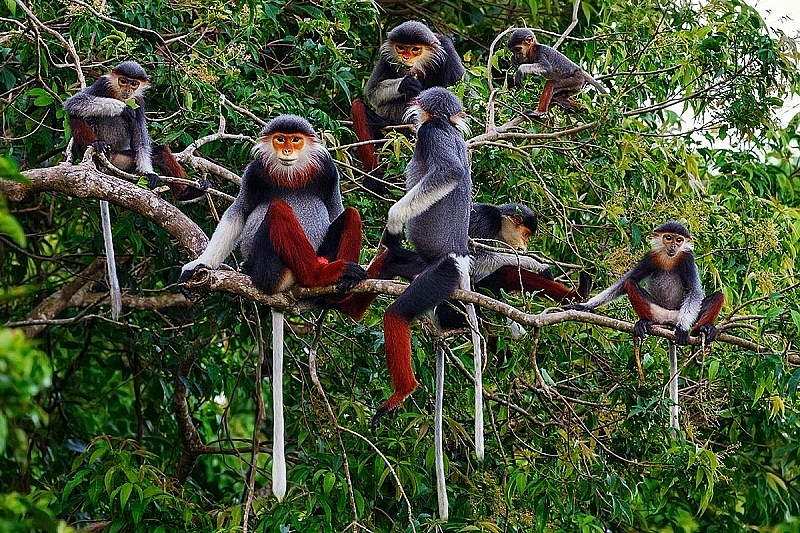 Gray-shanked douc langurs in Quang Nam (Illustration)
In Quang Nam, the GreenViet Biodiversity Conservation Center has recorded a group of gray-shanked douc langurs in Tam My Tay commune, Nui Thanh district, with nearly 70 individuals belonging to 8 families. They have the scientific name of Pygathrix cinerea and are a species endemic to Vietnam, distributed in the Truong Son region, in Quang Nam, Quang Ngai, Binh Dinh, Kon Tum, and Gia Lai provinces.
The gray-shanked douc langur lives entirely in trees, at altitudes of 300 meters or higher above sea level. They primarily feed on leaves, flowers, fruits, and seeds. Currently, there are approximately 1,500 - 2,000 individuals of this species listed as critically endangered in the International Union for Conservation of Nature (IUCN) Red List, making it one of the 25 most threatened primate species in the world.
Since 2017, the People's Committee of Quang Nam province has collaborated with various conservation agencies and organizations to conduct surveys. Recognizing the need to protect the douc langur population, the province has proposed a plan to purchase forest land for reforestation and to expand their habitat.
However, up until now, the habitat of the douc langur has not been expanded. The provincial authorities have instructed relevant departments and localities to review and determine the number of households and land areas in the proposed expansion area. The Tam My Tay commune government, in coordination with GreenViet, has developed a plan to promote awareness and encourage voluntary land donation from local households.
The proposed solution is to call upon businesses and sponsors to support households in voluntarily transferring their land to the state for management, in order to establish a special-use forest and a conservation area for the gray-shanked douc langur. Additionally, Quang Nam is also seeking cooperation from government agencies, organizations, individuals, and international sponsors to contribute to the conservation efforts for the douc langur.
While waiting for long-term and sustainable solutions to expand the langur's habitat, the local authorities are strengthening patrols and efforts to prevent threats to the douc langur population. The commune is maintaining forest protection teams and signing commitments with the community to refrain from hunting or trapping animals./.